Parking Lot Reclamation and Paving at a Strip Mall in Tamworth, NH
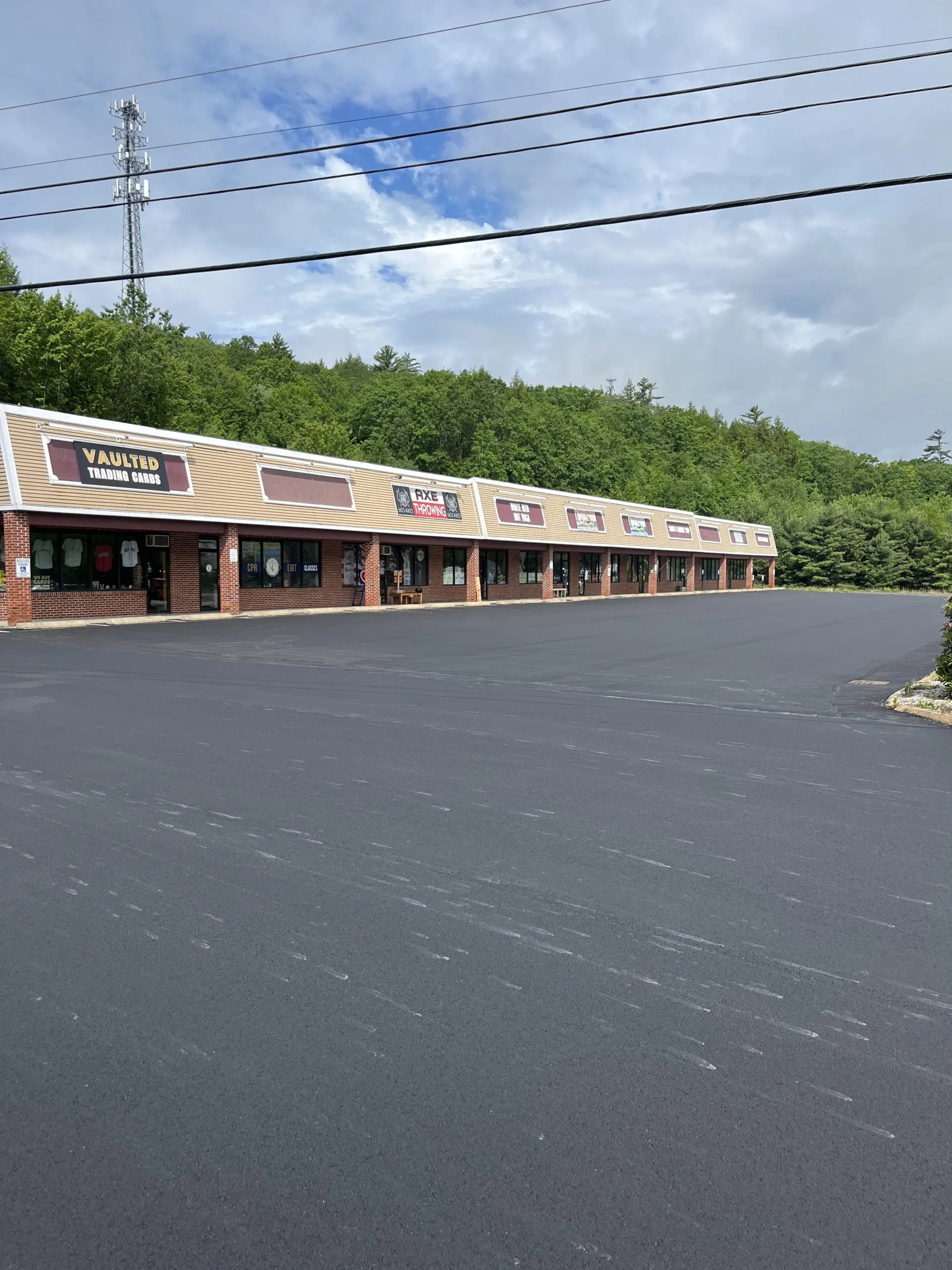
In June 2026, Young's Excavating & Paving LLC ground, reclaimed and repaved the parking lot of a strip mall at 680 White Mountain Highway in Tamworth, New Hampshire.
The existing asphalt was ground in place and reused as base, the base was graded and compacted, and a new 2.5-inch course of hot mix asphalt went down across approximately 32,200 square feet, about three quarters of an acre. Because the old surface became the new base, the lot was rebuilt from the ground up without a full dig-out.
View commercial paving and excavation work
Project overview
- Property: Strip mall, 680 White Mountain Highway, Tamworth, NH 03886
- Location: Tamworth, New Hampshire
- Project completed: June 2026
- Project type: Parking lot grind and reclaim, base preparation and new asphalt paving
- Approximate area: 32,200 square feet
- New asphalt: One 2.5-inch course of 3/4-inch hot mix asphalt, vibratory compacted, 2.5 inches total compacted thickness
- Work performed: Grind and reclaim, grading and vibratory compaction of millings and existing sub-base, removal of excess millings, saw-cut road edge, milling at the rear access road, catch basin preparation, tack coat on joints and milled surfaces, paving, edge tamping and compaction
What does it mean to grind and reclaim a parking lot?
Grinding and reclaiming means the old asphalt is pulverized where it sits and turned into the base for the new pavement instead of being hauled away. Our guide to full depth reclamation for parking lots covers when it is the right call.
A reclaiming machine grinds the existing surface into millings, which are then mixed with the gravel that was already under the lot. The result is graded to the finished shape and compacted with a vibratory roller until it is a dense, uniform base. Millings that are not needed to reach grade are removed. The same process is often called full depth reclamation.
At 680 White Mountain Highway, Young's ground and reclaimed the full parking lot, graded and vibratory compacted the millings and the existing sub-base, and removed millings as needed to hold the finished grade.
When does a parking lot need reclaiming instead of an overlay?
A lot is reclaimed when the old pavement can no longer be trusted as a foundation for new asphalt.
An overlay bonds a new layer to an existing surface, so it only works when that surface is sound. Pavement that has cracked in a grid across wide areas, broken up into loose pieces, or settled in many places will carry those problems straight up through a new layer, usually within a season or two.
Reclaiming resets the lot. The cracked surface stops being a surface and becomes aggregate in a fresh, compacted base, so the new asphalt is placed on structure rather than on old failures. It also avoids the cost of excavating the whole lot, trucking the material off and importing all new gravel.
Why are the millings graded and compacted before paving?
Because the millings are the base now, and asphalt only performs as well as the base under it.
Asphalt is a flexible surface. It spreads the weight of a vehicle down into the layers beneath it. If those layers are loose or uneven, the asphalt flexes until it cracks. Grading sets the slope so water leaves the lot, and vibratory compaction closes the material up so it does not move once traffic and frost get at it.
On this project the millings and the existing sub-base were graded and vibratory compacted as one layer before any new asphalt arrived.
Why saw-cut the edge where the lot meets the road?
A saw-cut gives the new asphalt a clean, vertical edge to tie into, so the joint at the road is straight, tight and flush.
Where a parking lot meets a public road, the new pavement has to finish level with pavement that is staying put. A ragged or feathered edge there cracks, catches plows and lets water into the joint. Saw-cutting the road edge at 680 White Mountain Highway created a clean tie-in point before the new course went down.
Why mill the area leading to the rear access road?
Milling grinds the existing pavement down where the new asphalt has to meet it, so the new surface ties in without a raised lip.
The rear access road at this property was staying in place. The area leading to it was milled so the new 2.5-inch course could finish flush with the existing pavement at the transition, instead of ending in a step that would catch plow blades and collect water.
Why are catch basins prepared before a lot is paved?
Because a catch basin only works if water can reach it, and paving changes the surface around it.
A catch basin is the drain in a parking lot. The pavement immediately around it has to slope toward the grate and finish at the right height, or water pools beside the basin instead of going into it. Standing water is the start of most pavement failures, especially through a New Hampshire winter.
At 680 White Mountain Highway the areas around the catch basins were prepared for proper water flow before the new asphalt was placed.
What is a single course of 3/4-inch hot mix asphalt?
It is one layer of asphalt placed in a single lift, using a mix whose largest stone is three quarters of an inch, rather than two separate layers of different mixes.
Many commercial lots are paved in two lifts, a coarser binder course and a finer surface course. A single construction course uses one mix for the full thickness. The 3/4-inch stone gives the layer strength under turning and truck traffic, and the mix still closes up to a tight surface when it is rolled.
On this project the new pavement was one 2.5-inch construction course of 3/4-inch single course hot mix asphalt, vibratory compacted to a total compacted thickness of 2.5 inches. The 2.5 inches is the thickness after rolling, not before.
Why is a tack coat applied to road joints and milled surfaces?
A tack coat is a thin bonding layer that makes the new asphalt grip what is under it instead of sitting on top as a separate skin.
It matters most where new asphalt meets old. At the saw-cut road joint and on the milled transition to the rear access road, the tack coat secures the bond so the joint does not open up and let water in. On this project the tack coat was applied to the road joints and the milled surfaces before the new course was placed.
Why are the edges tamped and compacted?
Because the edge of a parking lot is the weakest part of it, and an edge that is not compacted breaks away first.
A roller cannot reach the last few inches of an unsupported edge the way it reaches the middle of the lot. Tamping the edges and following with vibratory compaction closes up the asphalt there so it does not ravel under plows and wheel loads. At 680 White Mountain Highway the edges were tamped and vibratory compacted as the final step.
Why does the same contractor doing both halves matter?
A reclaimed lot is a site work job and a paving job in one scope, and on this project one company answered for both.
Grinding, grading and compacting the base is the excavation side of the work. Placing and rolling the asphalt is the paving side. When one contractor sets the base and a different one arrives later to pave it, nobody owns the part in between, and that is where lots fail.
Young's handles excavation and site work as well as asphalt paving, so what is under the pavement and what is on top of it are decided together. At 680 White Mountain Highway the reclaim, the grading, the drainage preparation and the paving were completed as one scope of work.
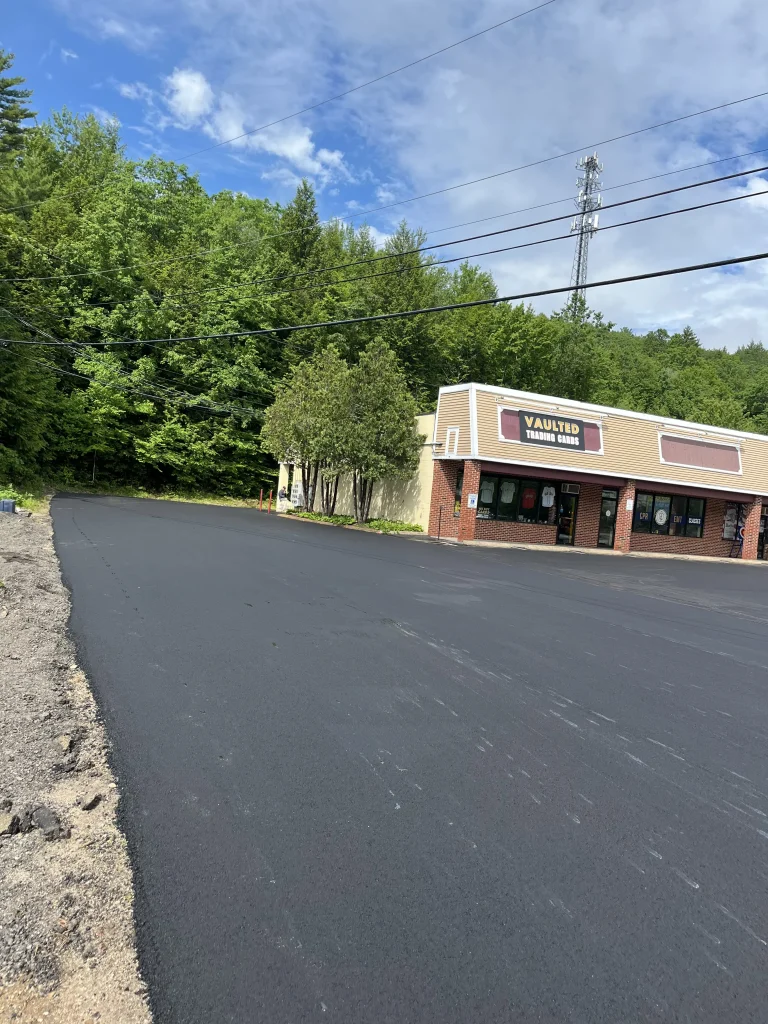
The completed parking lot in Tamworth
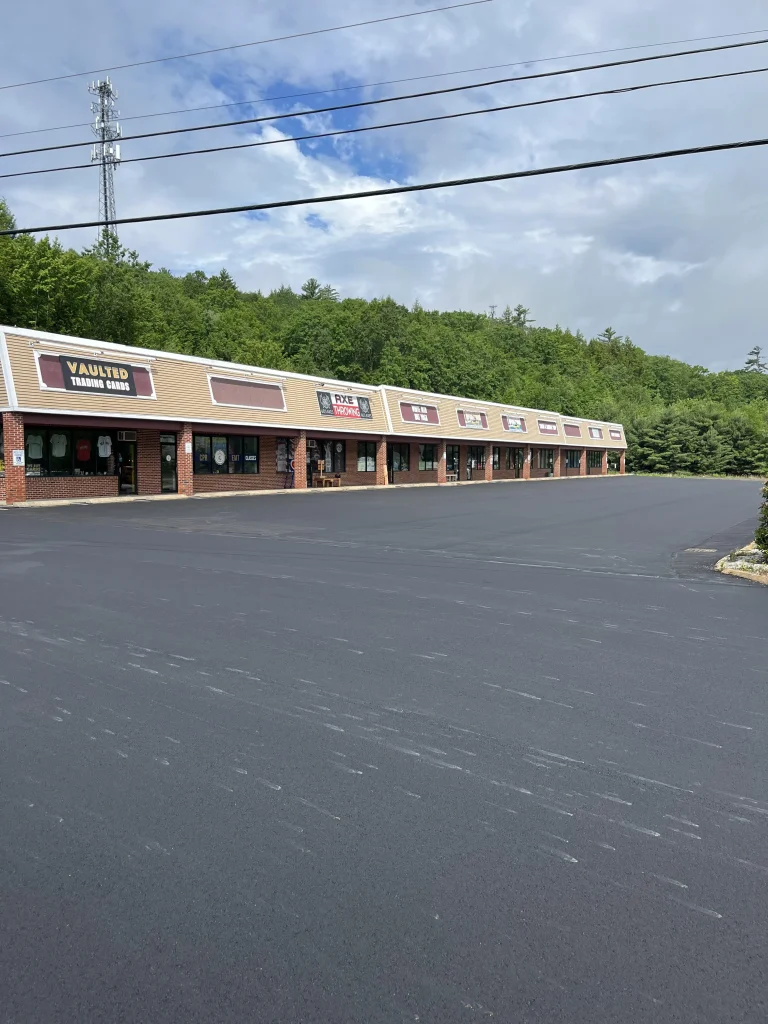
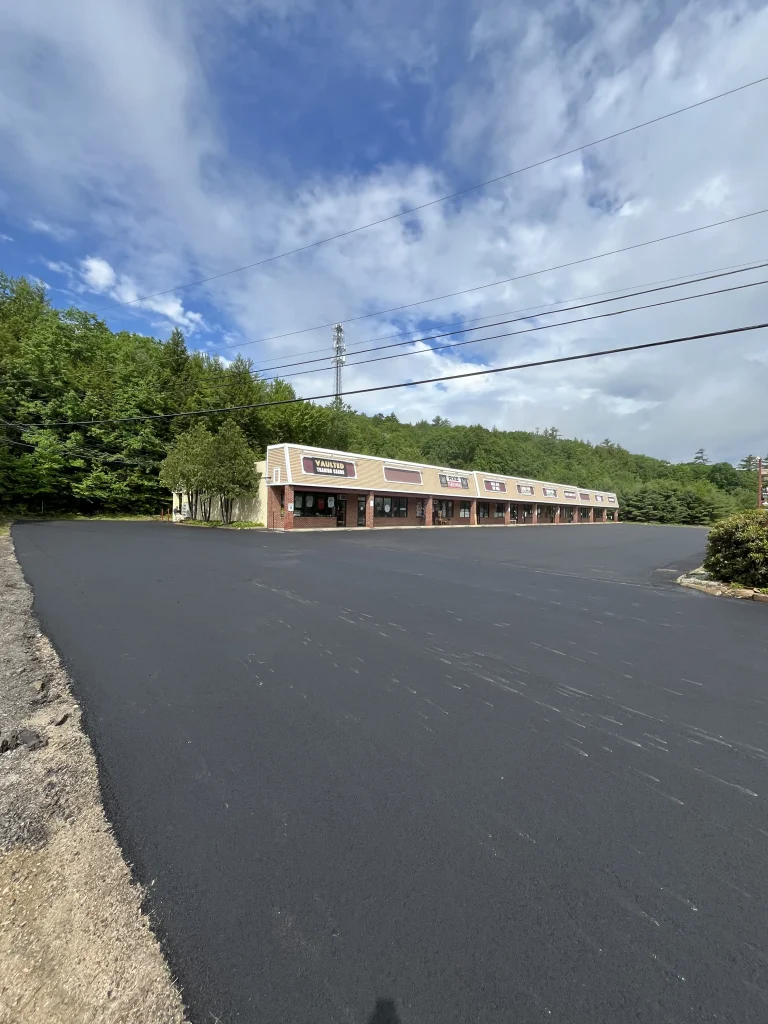
The finished job left the strip mall with a new, compacted base built from its own old pavement and a new 2.5-inch asphalt surface across roughly 32,200 square feet, tied in flush at the road and the rear access road and draining to its catch basins.
Who does parking lot reclamation and paving in New Hampshire?
Young's Excavating & Paving LLC, at 37 Washington Street in Penacook, handles commercial paving, excavation, grading and site work across six New Hampshire counties: Merrimack, Hillsborough, Rockingham, Strafford, Cheshire and Belknap. Larger commercial projects beyond those counties, like this one in Tamworth, are taken on by quote. The office number is (603) 231-1598 and the federal carrier registration is USDOT 2821639.
Commercial projects can mean a full grind and reclaim like this one, an overlay where the existing pavement is sound, repairs to failed areas, site preparation, grading, drainage work or pavement maintenance. Which of those applies depends on the condition of the existing pavement, the base beneath it, how the property is accessed and where water goes. The parking lot repairs and resurfacing at Summit Title Services in Bedford show the overlay side of that decision.
Request a commercial paving quote
To discuss a parking lot or a commercial paving project, call Young's Excavating & Paving LLC at (603) 231-1598 or request a free quote online.
Photographs, an approximate square footage and a description of any cracking, settlement, recurring potholes, drainage problems or access requirements help the team understand the property before scheduling a site visit.
Want to see more from Young's Excavating & Paving in your Google results and AI answers? Add us as a preferred source.
Button not showing? Add Young's Excavating & Paving on Google