
Paving Over a Gravel Driveway in New Hampshire
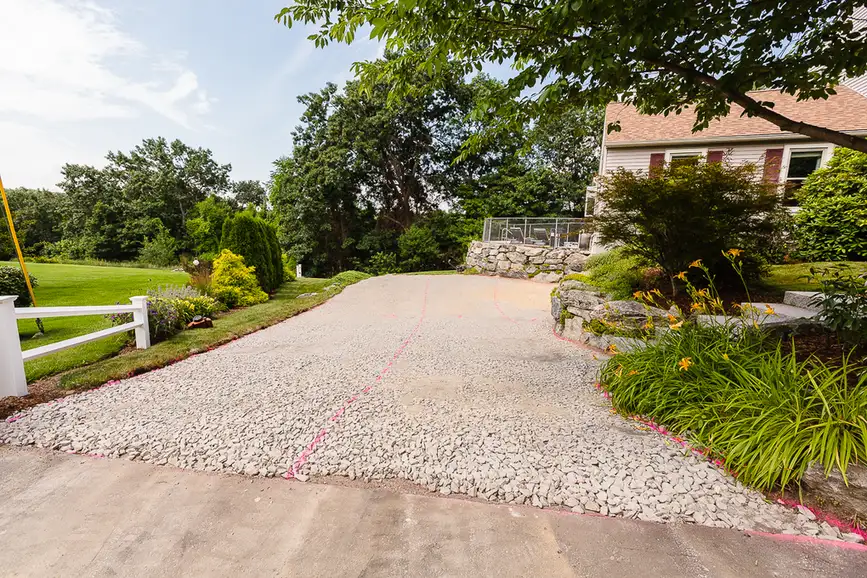
A gravel driveway that has been driven on for years looks like it should be the easiest thing in the world to pave: the shape is there, the ground is packed, and it drains well enough. Sometimes that is true. More often the gravel that is there is the wrong material, the wrong depth, or sitting on ground that was never compacted, and asphalt laid straight over it fails within a few winters.
This guide explains what has to happen between the gravel driveway you have and the asphalt driveway you want: how the existing base is judged, what gets added or removed, how it is graded and compacted, and how the asphalt itself is put down. It is written for New Hampshire, where frost decides most of it.
Can asphalt be laid directly on an existing gravel driveway?
Only when the gravel is a proper base: eight to twelve inches of crushed, well-graded stone, compacted, with a crown or pitch that moves water off. Most older gravel driveways in New Hampshire are not that. They are a few inches of bank-run gravel or round stone topped up over the years, sitting on native soil that holds water. Asphalt is a flexible pavement, and it is only as strong as what it rests on; a thin or soft base shows through as ruts, alligator cracking and sunken tire paths, usually within two to five winters.
The way to tell is not by looking at the surface. A test hole or two, dug with an excavator bucket to a foot or so, shows the actual depth of stone, what is under it, and whether water is sitting in it. A proof roll, driving a loaded truck slowly over the driveway and watching for pumping or rutting, shows whether the base moves under load. Both take less than an hour and settle the question.
What does the base need to be before paving?
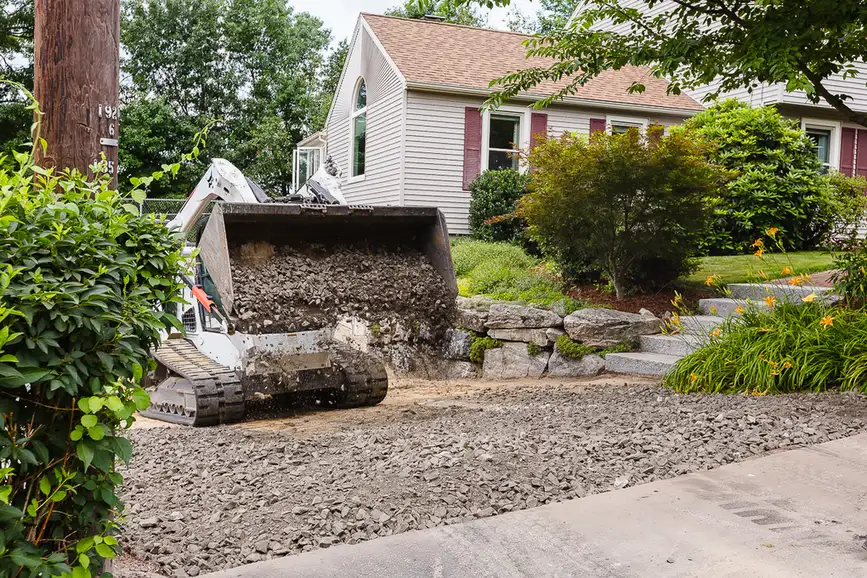
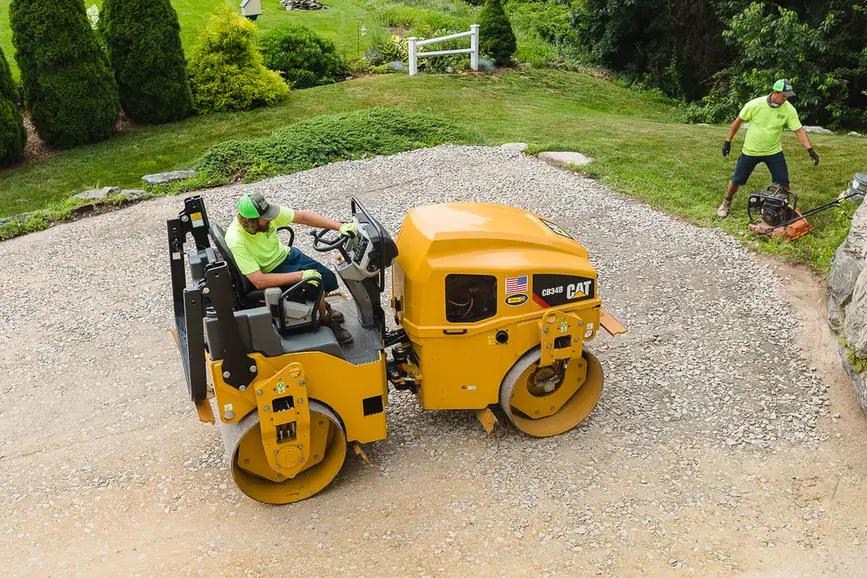
The standard for a residential driveway in New Hampshire is a crushed gravel base, commonly three-quarter-inch crushed stone with fines so it locks together, placed in lifts and compacted with a vibratory roller until it stops moving. Depth depends on the soil under it and what will drive on it. Well-draining sandy soil with cars only can work at eight inches. Clay, silt, ledge that traps water, or a driveway that sees plow trucks, deliveries and trailers wants twelve inches or more, and sometimes a layer of larger stone at the bottom to bridge soft ground.
Existing gravel is not wasted. Good crushed material stays and is graded into the new base. Round stone, organic material, topsoil that has migrated in from the edges and any soft, wet pockets come out. The frequent surprise on old driveways is that the outer foot or two of each edge is sitting on lawn rather than base; the driveway grew wider over the years as people drove around each other. Those edges get cut back to solid material or built up properly, because the edge is where asphalt fails first.
Grading and drainage come before the asphalt
Asphalt follows whatever shape the base has, so the pitch is set in the gravel, not the pavement. A driveway needs a fall of at least a quarter inch per foot across its width, or a crown in the middle, so water leaves the surface instead of soaking through the joints and edges into the base. Where a driveway runs downhill toward a garage, the grading includes somewhere for that water to go: a swale along the side, a trench drain at the garage, or a change in pitch before the door. The guide on driveway drainage in New Hampshire covers the options.
Compaction is the step that cannot be rushed. Each lift of base, typically four to six inches, is rolled until a vibratory roller no longer leaves a mark. Base that is placed all at once and rolled once looks the same on the day and settles for the next two years.
How thick is the asphalt on a converted gravel driveway?
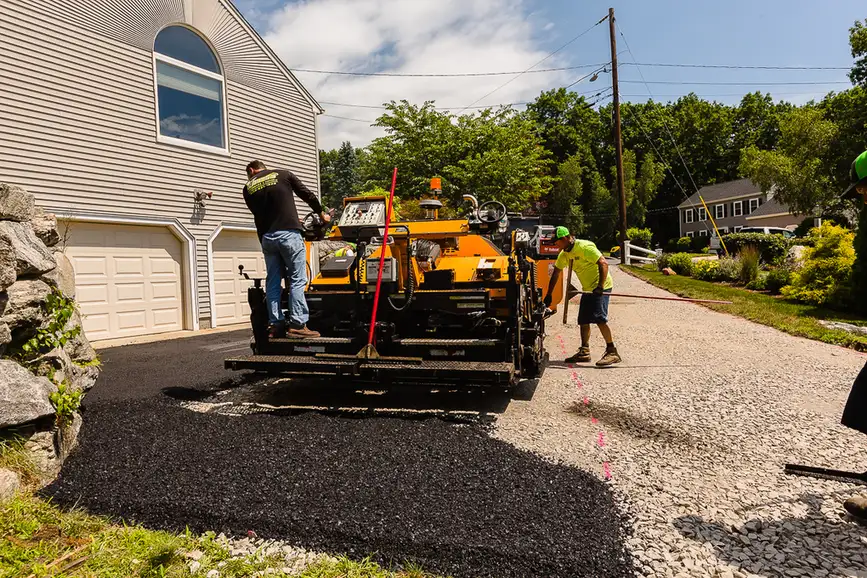
A residential driveway in New Hampshire is normally paved in two lifts: a binder course of coarser mix, around two inches compacted, and a top course of finer mix, around one and a half inches compacted, for a finished thickness of three to three and a half inches. Some contractors quote a single two-inch lift over a converted gravel driveway. It is cheaper and it is thinner than the driveway will need over frost, plow blades and delivery trucks; it is the kind of saving that shows up as an overlay bill in year six. For how thickness, base work and size drive the price, see driveway paving cost in New Hampshire.
The mix is placed with a paver at roughly 300 degrees and rolled while it is hot. Cold weather closes that window, which is why gravel-to-asphalt conversions are a May-to-October job here. The guide on when to pave a driveway in New Hampshire explains the season limits.
What does converting a gravel driveway involve, start to finish?
The sequence on a typical job: test holes and a look at where water goes; excavation of unsuitable material and the soft edges; import and placement of crushed gravel in lifts, each one compacted; final grading to the pitch and crown; a check of the base by proof roll; the binder course, rolled; the top course, rolled; and the edges backfilled with loam or stone so the pavement is supported on the sides. A driveway that needs a full base rebuild takes two to three days including the base work; one that already has a sound base can be paved in a day.
The excavation and the paving are two different trades, and on most driveways they are two different companies. That is where converted gravel driveways go wrong: the paver arrives to a base someone else built and paves what is there. Young's Excavating & Paving LLC does the site work and the asphalt paving as one company, so the base is built by the people who then have to stand behind the surface on it. More on that in the guide to excavation and paving with one New Hampshire contractor.
Is it worth paving a gravel driveway?
Gravel driveways in New Hampshire cost time every year: grading after mud season, topping up what the plow pushed into the lawn, filling the potholes that form where water sits. Asphalt removes that maintenance, plows clean, and holds its shape through freeze and thaw if the base under it was built for it. The difference between a converted driveway that lasts twenty years and one that lasts five is almost entirely in the base work described above, which is also where the quotes differ most. A low quote for paving over gravel usually means the gravel is being paved over as found.
Who converts gravel driveways to asphalt in New Hampshire?
Young's Excavating & Paving LLC, at 37 Washington Street in Penacook, builds driveway bases and paves them across Merrimack, Hillsborough, Rockingham, Strafford, Cheshire and Belknap counties. Every gravel-to-asphalt quote starts with a look at the existing base, and the quote says what is being kept, what is being removed and how many inches of new gravel are going in, so it can be compared with any other. Call (603) 231-1598 or request a free quote.
Want to see more from Young's Excavating & Paving in your Google results and AI answers? Add us as a preferred source.
Button not showing? Add Young's Excavating & Paving on Google