
Driveway Drainage in New Hampshire
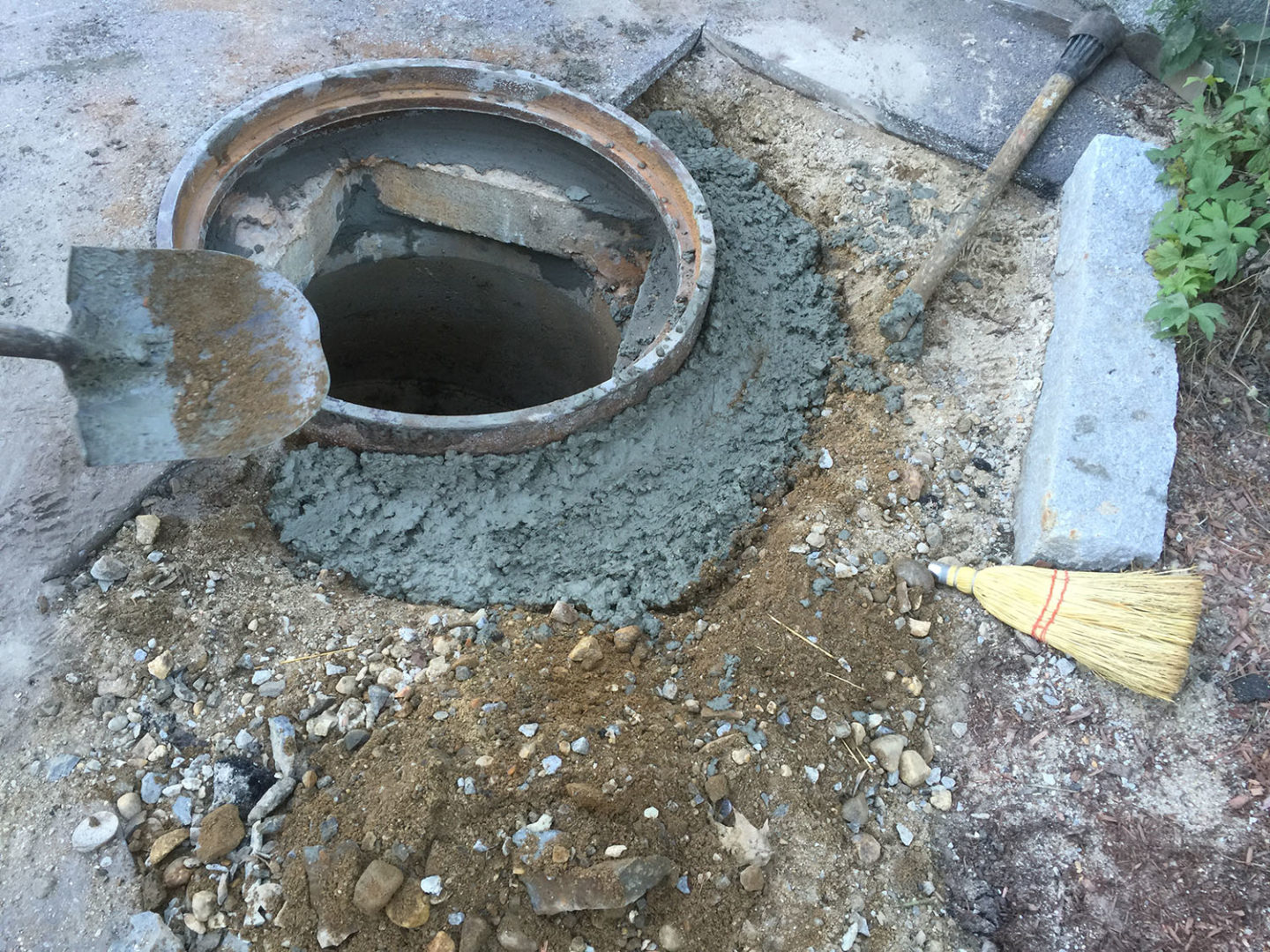
Almost every asphalt problem in New Hampshire is a water problem wearing a different coat. Cracking, edge failure, potholes and the soft spot that keeps coming back are usually the surface reporting on something happening underneath it. Drainage is the part of a driveway nobody photographs and the part that decides how long the rest of it lasts.
This guide covers how water is supposed to move off a driveway, what goes wrong when it does not, and what can be corrected without tearing the whole surface out. It is written from the excavation side of the job as much as the paving side, because that is where drainage is actually built.
Why does water pool on my driveway in New Hampshire?
Standing water means the surface has nowhere to send it. Usually that is one of four things: the driveway was built with too little pitch, the pitch runs the wrong way, the ground it drains toward has risen over the years from landscaping or settled fill, or a low spot has developed where the base compacted unevenly.
New Hampshire adds a fifth. Water that sits on asphalt in October gets into the surface, freezes in November, and expands. Freeze and thaw cycles run through the whole winter here, not once, so a puddle is not a cosmetic complaint. It is a crack being manufactured on a schedule. The same mechanism is covered in more detail in our guide to why New Hampshire driveways crack.
What pitch does an asphalt driveway need?
As a general rule an asphalt driveway needs at least one to two percent of fall to shed water reliably. That works out to roughly an eighth to a quarter of an inch of drop for every foot of run. It is a small enough slope that most people never notice it underfoot, and it is the difference between a surface that dries after a storm and one that holds a sheet of water.
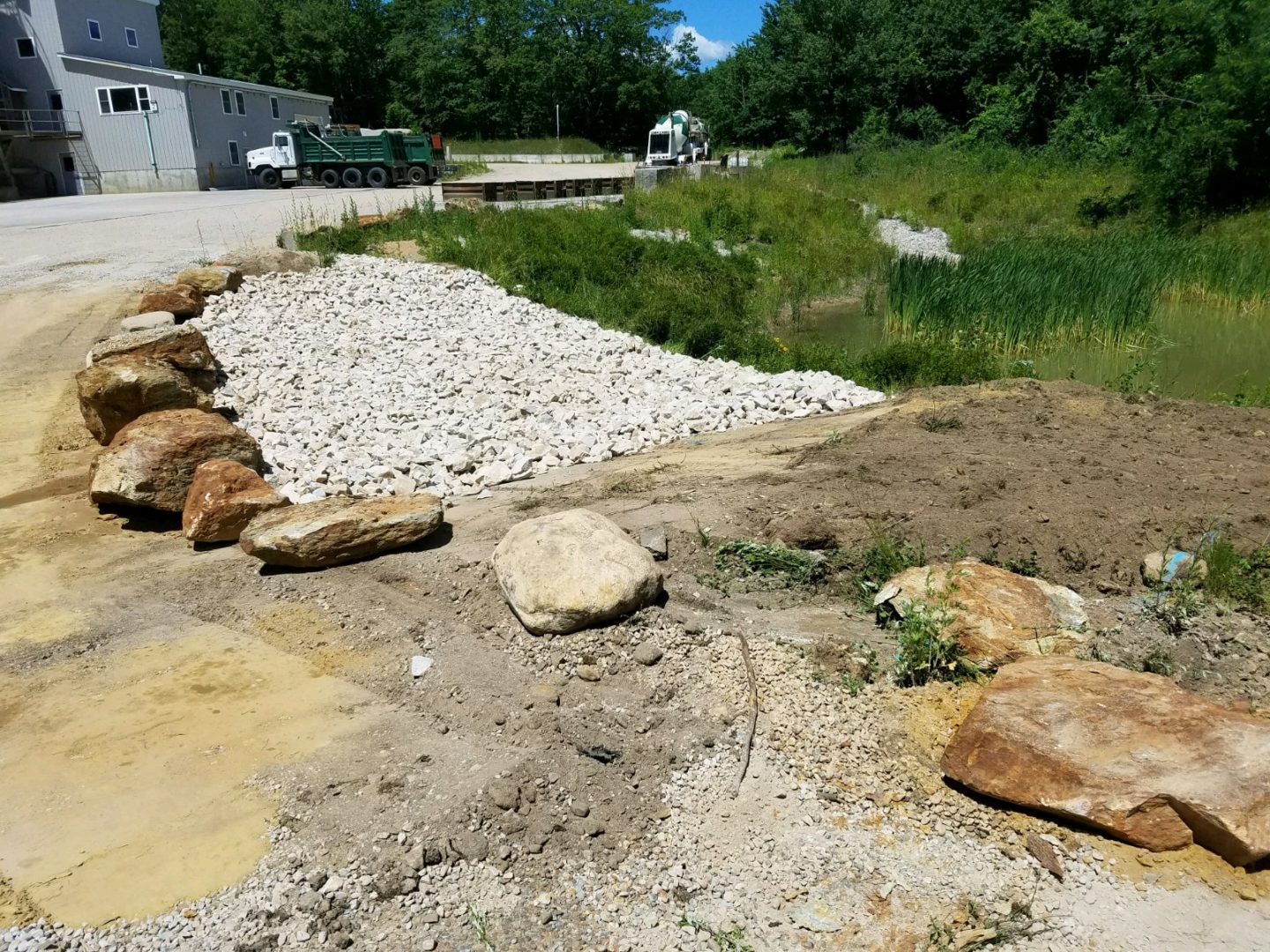
Pitch alone is not the whole answer, because the fall has to end somewhere useful. A driveway pitched beautifully into a flowerbed that cannot absorb it has simply moved the problem four feet. Setting the grade and deciding where the water lands are the same decision, made at the same time, before any asphalt exists.
Where should driveway water go if there is no storm drain?
Most rural and suburban New Hampshire properties have no municipal storm drain to tie into, so the water has to be managed on the lot. The common options are a swale that carries it along a shallow grassed channel, a dry well that holds it while it soaks in, a pipe daylighted to a lower point on the property, or a rain garden built to absorb it.
One rule sits above all of those. Water should not be redirected onto a neighboring property. Beyond being a reliable way to start an argument, concentrating runoff onto land that was not built to take it can cause real damage, and in some New Hampshire towns it raises a permitting question. A drainage plan that solves your driveway by flooding somebody else's has not solved anything.
What is a trench drain, and when does a driveway need one?
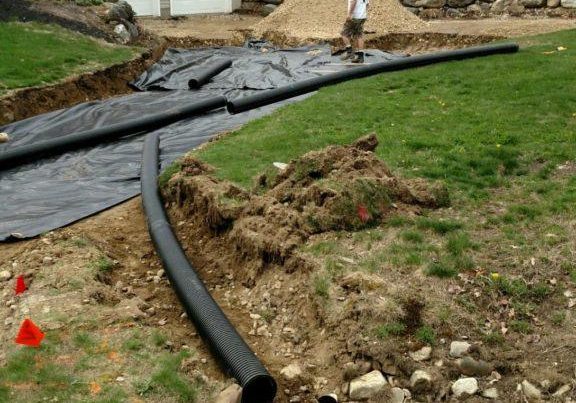
A trench drain, sometimes called a channel drain, is a long narrow grate set flush into the surface that catches water across its whole length and pipes it away. A catch basin does a similar job at a single point, collecting water into a box with a sump at the bottom that traps sediment before it reaches the pipe.
A driveway needs one when the grade cannot do the work on its own. The classic case is a driveway that slopes down toward a garage or a walkout basement, where there is no lower ground to send water to. A trench drain across the apron intercepts it before it reaches the building. The second common case is a long driveway where water picks up volume as it runs, and needs to be taken out partway rather than delivered all at once at the bottom.
Why do New Hampshire driveways fail at the bottom of a slope?
Because that is where the water collects and stops moving. Everything that ran down the driveway arrives at the low end, and if it has nowhere to go it sits and soaks into the base through the edges and through any crack it finds.
A saturated base loses its bearing strength. Then the freeze and thaw cycle lifts and drops it through the winter, and by spring the surface above has lost its support. That is why the bottom of a slope is often the first place a driveway alligators or sinks, even when the rest of the surface looks sound. Edge failure at the same low point is common too, which is what backfilling and shouldering is meant to prevent.
Can driveway drainage be fixed without repaving the whole driveway?
Often yes, and it is worth asking before agreeing to a full replacement. Adding a trench drain at the apron, setting a catch basin at a low point, regrading a single problem section, cutting a swale alongside, or rebuilding a failed shoulder are all targeted repairs that leave the majority of the surface in place.
Sometimes the honest answer is no. If the base underneath is saturated and has already lost its structure across a wide area, drainage added on top of it is a repair sitting on a foundation that is still failing. Telling those two situations apart means looking at the base, not the surface, which is a large part of why we would rather quote a drainage problem in person than over the phone.
What causes ice buildup at a garage apron in New Hampshire?
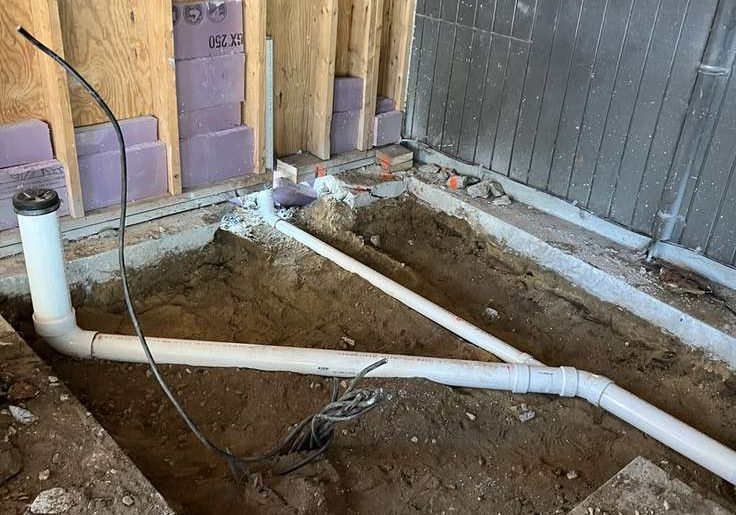
Ice at the garage door almost always means water is arriving there and stopping. Either the apron is pitched slightly toward the building instead of away from it, or the driveway above it drains to that point and has no outlet once it gets there.
It is worth taking seriously in this climate rather than salting through another winter. Water sitting against a garage slab freezes, expands, and works at the joint between the slab and the asphalt, and repeated freezing at a doorway is a slip hazard on the part of the property people use every day. The fix is usually a combination of correcting the pitch on the apron and giving the water somewhere to be collected.
Who handles driveway drainage near Concord, New Hampshire?
Young's Excavating & Paving LLC does. We are based at 37 Washington Street in Penacook, minutes from Concord, and we work across six New Hampshire counties: Merrimack, Hillsborough, Rockingham, Strafford, Cheshire and Belknap. Our federal carrier registration is USDOT 2821639.
Drainage sits exactly on the seam where most driveway jobs get split between two companies, with an excavation contractor setting the grade and a paving contractor laying the surface over whatever they find. We do both halves with the same crew, so the pitch, the drainage and the pavement are one set of decisions rather than a handoff. That connection is the subject of our guide on excavation and paving with one New Hampshire contractor, and you can see how a job runs from raw ground to finished surface on our How We Work page.
If water is going the wrong way on your property
request a free quote or call (603) 231-1598. The full list of counties and towns we cover is on our Areas We Serve page.